How Long Does It Take for Eyelashes to Grow Back? A Physician's Guide to the Lash Growth Cycle

By Susan F. Lin, M.D. | Physician · Inventor on U.S. Patent 8,206,695 (eyelash enhancement) · Contributing Author to Harry’s Cosmeticology, 9th Edition | Reviewed: June 2026
Quick Answer
After complete eyelash loss, initial regrowth typically takes 6-8 weeks and full length and density restoration takes 12-16 weeks. The complete lash growth cycle runs 4-11 months total — anagen (active growth) only 30-45 days, catagen 15 days, telogen (rest then shed) about 100 days. Only 35-40% of lashes are actively growing at any moment, which is why honest assessment of any lash conditioner takes a full 12-16 weeks. The exact timeline depends on the underlying cause of loss: mechanical trauma recovers fastest; telogen effluvium takes 6-9 months; hypothyroidism requires treatment of the underlying condition first; severe follicular scarring from chronic over-tweezing or chemical damage may not fully regrow. Supporting the follicle environment with a clinically tested eyelash conditioner like MD Lash Factor® (U.S. Patent 8,206,695; peer-reviewed published study, JCLT 2008, PMID 18569264) can accelerate visible recovery within this honest biological timeline.
The eyelash growth cycle — why it takes months
The eyelash growth cycle is fundamentally different from scalp hair. Scalp hair sits in anagen (active growth) for 2-7 years; eyelashes sit in anagen for only 30-45 days. Scalp hair has 85-90% of its follicles in growth at any moment; eyelashes have only 35-40%. This is the biology that determines how long lash regrowth takes — and why honest products quote 12-16 weeks for full assessment.
| Phase | Duration | % of lashes at any moment | What happens |
|---|---|---|---|
| Anagen (growth) | 30-45 days | 35-40% | Matrix cells divide and build the new lash shaft |
| Catagen (regression) | ~15 days | ~10% | Lash separates from dermal papilla; follicle structures involute |
| Telogen (rest then shed) | ~100 days | ~50% | Club lash anchored; follicle prepares for next anagen, then sheds |
The math: a typical eyelid has ~200-300 lashes per eye when healthy. If complete loss occurs (eg from an eyelash extension lift-off), some follicles are already in early anagen and will produce visible new lashes within 6-8 weeks. Others sit in telogen and need 2-4 months to re-enter anagen before producing any new shaft. The result: 6-8 weeks for initial appearance, 12-16 weeks for substantial restoration, and 4-6 months for the lash population to fully cycle through.
Regrowth timeline by underlying cause
| Cause | Initial regrowth | Full restoration |
|---|---|---|
| Single mechanical event (curler accident, extension lift-off) | 6-8 weeks | 12-16 weeks |
| Chronic mechanical trauma (recurrent curling, rubbing) — after stopping | 8-12 weeks | 4-6 months |
| Allergic reaction — after discontinuing trigger | 6-10 weeks | 3-5 months |
| Telogen effluvium (postpartum, illness, stress) | 3-4 months | 6-9 months |
| Hypothyroidism — after treatment with levothyroxine | 3-4 months | 6-9 months |
| Nutritional deficiency — after restoring (iron, biotin, protein) | 3-4 months | 6-9 months |
| Alopecia areata (variable response) | Variable | Months to years, sometimes incomplete |
| Chemotherapy — after cycle ends | 4-8 weeks | 3-6 months |
| Severe follicular scarring (decades of chronic damage) | Often incomplete | May not fully restore |
The honest physician answer: most lash loss recovers fully if the underlying cause is identified and addressed. Severe scarring (typically from decades of aggressive over-tweezing or repeated chemical burns) is the exception — the follicles themselves may be lost. For those cases, supporting whichever follicles remain with consistent daily conditioning is the realistic strategy.
Factors that affect regrowth speed
- Age — follicle activity slows with age; younger users see faster regrowth than older users
- Underlying cause — mechanical trauma recovers faster than systemic causes; chronic damage recovers slower than single events
- Nutritional status — iron (ferritin > 70), vitamin D, B12, biotin, adequate protein all support faster regrowth
- Thyroid status — untreated hypothyroidism prevents regrowth even with topical support
- Hormonal status — postpartum, perimenopause, and post-menopause all affect lash cycle timing
- Daily conditioning with a clinically tested eyelash conditioner — supports the follicle environment during the months-long cycle
- Avoidance of further trauma — stop curlers during recovery; gentle makeup removal; no extensions during the restoration window
How to support faster regrowth
1. Identify and address the underlying cause
Mechanical trauma: stop curling, switch to gentler makeup removal, avoid extensions. Allergic reaction: discontinue the offending product. Hypothyroidism: see your physician for TSH and free T4, treat with levothyroxine. Nutritional deficiency: targeted blood panel + dietary or supplement correction. Telogen effluvium: address underlying systemic trigger (postpartum recovery, stress management, illness resolution).
2. Support the follicle environment topically
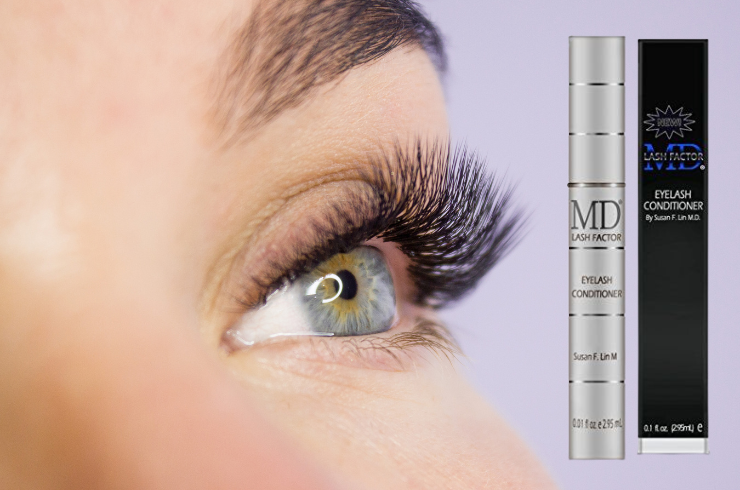
MD Lash Factor® is a physician-formulated eyelash conditioner designed to support the lash follicle environment during the months-long growth cycle. The original formulation uses dechloro ethylcloprostenolamide (cosmetic-concentration prostaglandin-family compound, U.S. Patent 8,206,695) developed by Dr. Susan Lin, M.D. It does not contain bimatoprost, latanoprost, or any prescription-grade prostaglandin drug. To our knowledge, the original MD Lash Factor remains the only cosmetic prostaglandin-containing eyelash conditioner backed by a published peer-reviewed clinical safety and efficacy study (Choy & Lin, JCLT 2008, PMID 18569264).
For consumers who prefer a non-prostaglandin approach, MD Lash Factor also offers a peptide-based formulation with no prostaglandin-family compounds. Both formulations have been evaluated through independent IRB-protocoled ocular safety studies and have been found safe and efficacious. Supporting actives in both formulations include biotin, panthenol, thiotaine, and a peptide complex.
3. Support follicle biology nutritionally
Iron (ferritin > 70 ng/mL), vitamin D (> 30 ng/mL), B12, biotin (modest dose, not megadose), adequate protein (0.8–1.0 g per kg body weight daily). These are the building blocks the matrix cells need to construct new lash shaft.
4. Stop active damage
During the regrowth window, treat lashes gently: warm water and a gentle cleanser for makeup removal (no aggressive rubbing), no lash curlers, no eyelash extensions, no mascara during the first 2-3 weeks if lash loss was significant. Allow follicles to recover before adding any styling load.
5. Be patient and consistent
The lash growth cycle is months long. No topical product, supplement, or technique can shortcut it. Consistent daily use of a clinically tested conditioner over the full 12-16 week assessment window is what gives the biology time to respond.
When to see a physician
- Lash loss is focal (one area only)
- Lash loss is sudden and complete in patches — may be alopecia areata
- Lash loss accompanies outer eyebrow thinning — evaluate thyroid (Hertoghe sign)
- Lashes are missing in a focal pattern on one eyelid only with no other explanation
- Lash loss persists more than 3 months without identifiable cause
- Symptoms include vision changes, eye pain, or persistent redness
Frequently asked questions
How long does it take eyelashes to grow back?
Initial regrowth: 6-8 weeks. Full restoration: 12-16 weeks for cosmetic causes, 6-9 months for systemic causes (telogen effluvium, hypothyroidism, nutritional).
What are the phases of the eyelash growth cycle?
Three phases: anagen (active growth, 30-45 days), catagen (regression, 15 days), telogen (rest then shed, 100 days). Only 35-40% of lashes are actively growing at any moment.
What factors affect lash regrowth speed?
Age, underlying cause of loss, nutritional status (iron, biotin, protein), thyroid status, hormonal status, and use of a daily eyelash conditioner. Severe follicular scarring may not fully restore.
Can MD Lash Factor speed up regrowth?
MD Lash Factor cannot shortcut the biological cycle, but it supports the lash environment during the months-long recovery. The published study demonstrated statistically significant lash lengthening and densification over 4 weeks with no clinically meaningful changes in visual acuity or intraocular pressure.
How often should I apply lash conditioner?
Once nightly is correct. More frequent application does not produce faster results and may increase irritation risk.
Is it normal to lose 1-2 lashes per day?
Yes. Normal daily loss is 1-5 lashes per eye. 5-10 daily suggests an active trigger. Persistently above 10 warrants medical evaluation.
About the Author
Susan F. Lin, M.D. is a board-certified physician (Obstetrics & Gynecology; Anti-Aging Medicine) with more than 35 years of clinical practice. She is the inventor of MD Lash Factor® and holds multiple patents for eyelash-enhancement compositions, including U.S. Patent 8,206,695, Chinese Patent CN 102172344, and an international WIPO filing. Her peer-reviewed research has been published in the Journal of Cosmetic and Laser Therapy, and she is a contributing author to Harry’s Cosmeticology, 9th Edition (Part 3.3.5, Eyelashes, pp. 480-486).
Related reading
- Eyelash Anatomy & Growth Cycle — A Physician’s Guide
- Why Are My Eyelashes Falling Out? — Physician’s Guide
- Is Your Eyelash Serum Safe? — Reading Lash Conditioner Labels
- How to Choose a Safe Lash Serum — Clinical Evidence Framework
- MD Lash Factor Clinical Evidence Dossier
Featured product
- MD Lash Factor® — Physician-formulated by Dr. Susan Lin, M.D., U.S. Patent 8,206,695, peer-reviewed published clinical study (JCLT 2008, PMID 18569264). Two formulations: original (cosmetic prostaglandin-family) and new (peptide-based). Both backed by independent IRB-protocoled ocular safety studies.
Cited literature
- Choy I, Lin SF. A new eyelash care system stimulates eyelash growth: a randomized, double-blind, placebo-controlled study. J Cosmet Laser Ther. 2008;10(2):117–122. PMID: 18569264. DOI: 10.1080/14764170802054138.
Educational only; not a substitute for individualized medical advice. If you are experiencing sudden or focal lash loss, vision changes, persistent ocular symptoms, or lash loss accompanied by skin changes, please consult a licensed ophthalmologist, optometrist, or dermatologist.